
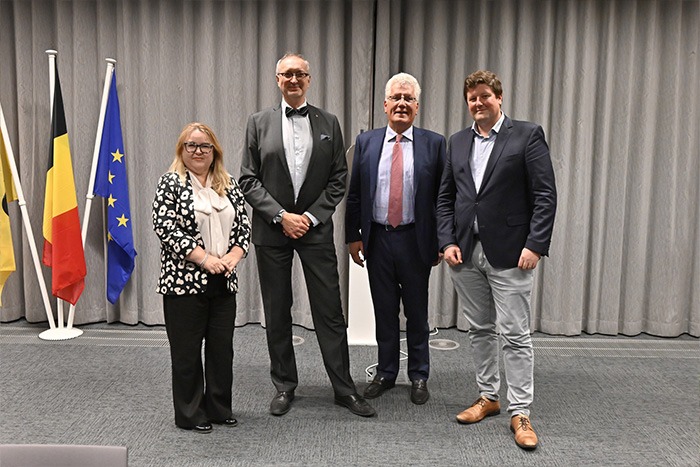
The Tervuren Municipal Council meeting opened at 8:10 p.m. Several absences were noted: Omer Graulus, Tracey D’Afters, Willy Roykens, and Lionel de Beaufort, the latter having requested the postponement of his oral question. Councillor Bram Peters then announced that he would be replaced during the next three sessions due to a stay abroad. Joan Abatesi will take his seat as the first substitute.
Acknowledgement of the letter from Minister H. Crevits following a complaint by Elmo Peeters (Groen+Vooruit):
The complaint concerned the amendment to the Council’s Internal Rules of Procedure, approved at the previous council meeting, which grants the council president the discretion to refuse an agenda item deemed insufficiently motivated or too vaguely described (Art. 3§2 HHR). Councillor Peeters argued that this discretionary power could lead to abuse or arbitrary decisions, and restrict councillors’ freedom to introduce agenda items. Minister Crevits dismissed the objection, stating that this power only serves to verify compliance with existing statutory formal requirements for additional agenda items, namely the obligation to submit a motivated decision proposal.
Update of the code of ethics for officeholders
The update of the code of ethics for officeholders, resulting from the latest meeting of the group leaders, was presented. The changes concerned only minor wording clarifications; the text was adopted unanimously.
2024 Annual Report on Organisational Management
The 2024 annual report on organisational management was also approved unanimously, without debate.
Adjustment of the subsidy regulations of the autonomous municipal company (AGB) Bexit
The fifth item concerned the adjustment of the subsidy regulations of the autonomous municipal company (AGB) Bexit for 2025. TU+Volt Councillor Serge Liesenborghs asked whether the new coefficient of 1.21 corresponded to the VAT rate; Alderman Trappenier clarified that this was a coincidence. Serge Liesenborghs also asked how often the coefficient was re-evaluated; the answer was: twice a year. The significant decrease in the factor, due to investments not carried out, prompted a brief technical exchange. The regulation was then approved unanimously.
Multi-annual Plan 2026-2031
The Council then adopted, without discussion, the 2026–2031 multi-annual plan of Saint Paul’s Anglican Church, and took note of the 2026 budget of the same institution.
Adaptation of the municipal regulation on subsidies for the renovation of commercial façades
The assembly also unanimously approved the adaptation of the municipal regulation on subsidies for the renovation of commercial façades, without comments from the opposition groups or members of Tervuren Unie + Volt. This measure provides an intervention of 30% of the costs, up to a maximum of €1,000, renewable after 10 years.
Mobility in Ortar De Pauw and Lindeboom Streets
A more substantive debate arose on mobility in Ortar De Pauw and Lindeboom Streets. Councillor Carine Borghans recalled the nuisances observed: excessive speed, heavy traffic towards the schools, and difficulties in coexistence between pedestrians and cyclists. She proposed that the municipal services develop several scenarios to improve safety and quality of life, in consultation with residents.
Alderman Marc Charlier stated that traffic counts carried out in Lindeboomstraat showed no major anomalies, except for slight excesses at midday, and that the increased traffic was due to the temporary closure of the park, which was scheduled to reopen before the end of the year. According to him, the situation should then normalise. He considered that a full scenario study was not justified, but agreed to examine targeted measures: additional signage or protective bollards.
Councillor de Visscher (Tervuren Unie + Volt) intervened to request the precise reopening date of the park, in order to assess the impact of the diversion traffic; the majority confirmed that the works would be completed before the Christmas holidays. This intervention helped clarify the schedule and bring the discussion back to factual grounds.
Oral questions:
- The oral question on the summer linden tree in Duisburg, raised by Bram Peters, led to an extensive exchange. Alderman Charlier explained that the summer pruning had been carried out by the company Treeworks, specialised and certified at the European level. The work consisted of removing dead wood and alleviating pressure on the roots. Additional analyses are planned regarding the fungi present and soil stability, but they require suitable weather conditions. The tree is still considered viable, although its visual appearance is affected. Peters recommended consulting a specialist in veteran trees and mentioned the impact of heavy traffic on the root system. Charlier replied that a re-evaluation of traffic could be considered if the study’s findings confirm a risk. This exchange highlighted the shared concern for preserving the municipality’s tree heritage, a recurring theme put forward by the Tervuren Unie + Volt group.
- The oral question on the new Bindend Sociaal Objectief 2026–2042, introduced by Borghans, addressed social housing policy. Councillor Lut Kint, also a board member of the housing company Woontrots, noted that the new Flemish objective foresees the creation of 50,000 social housing units in Flanders, including 139 in Tervuren (provisional figure, including 38 catch-up units).
She detailed the local projects under preparation:- the Kleine Ham site (40 to 50 units),
- the renovation and densification of the Ravenstein estate (+20 units),
- the renovation of the De Linde building (50 to 52 units).
She specified that 104 existing Vlabinvest units are not included in the official figures, a point currently under discussion with Woontrots management. Other instruments – rental of private dwellings via the SVK Pro system, and participation in the CBO procedure for private projects with social purposes – are also being considered.
Alderman Charlier added that no specific social housing obligation was foreseen, but that a “Wonen in eigen streek” regulation would support housing access for local residents.
At this stage, Serge Liesenborghs (Tervuren Unie + Volt) intervened to request clarifications on the planning of the Kleine Ham and Ravenstein projects, seeking to determine the implementation schedule. His intervention highlighted the need for a clear timeline for the BSO rollout.
The alderman replied that no precise date could yet be set, as priority is given to existing renovation projects. Charlier added that a preliminary mobility study would be required for the densification of Ravenstein, delaying any concrete steps to the medium term.
No further interventions were recorded, and the Municipal Council meeting was adjourned.
The meeting of the OCMW Council followed immediately, with three items: approval of the minutes of 28 August, validation of the code of ethics (identical to that adopted by the Municipal Council), and the 2024 annual report on organisational management. All three items were approved unanimously, without debate.
In conclusion, this September 2025 session, generally consensual and swift, approved several administrative and budgetary adjustments without major controversy. The most substantial exchanges concerned local mobility, preservation of tree heritage, and social housing policy. The interventions of the Tervuren Unie + Volt group, notably those of Serge Liesenborghs and Geoffroy de Visscher, stood out for their precise and constructive questions, contributing to clearer public information on the concrete timelines of municipal projects.
